Early-stage NSCLC
KEYTRUDA® (pembrolizumab) for early-stage NSCLC
Prescribing Information [External link]
A key to more possibilities for treating your appropriate patients with early-stage NSCLC, regardless of PD-L1 expression1–4
Learn more about how KEYTRUDA can benefit your patients with early-stage NSCLC from the KEYNOTE trial data:

KEYNOTE-6713
Neoadjuvant KEYTRUDA + chemotherapy, followed by adjuvant KEYTRUDA monotherapy

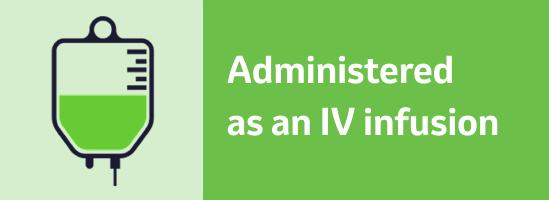
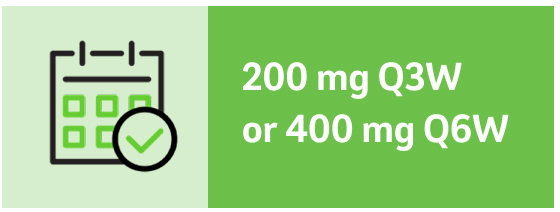
KEYTRUDA offers flexibility of dosing1

Assessment of regimens
The 200 mg Q3W (once every 3 weeks) regimen has been assessed in phase 2 and 3 registration studies across a multitude of indications of KEYTRUDA. An exposure-response evaluation, using modelling and simulation, led to the approval of the 400 mg Q6W (once every 6 weeks) dosing for monotherapy and combination therapy.1
From a microbiological point of view, the product, once diluted, should be used immediately. The diluted solution must not be frozen. If not used immediately, in-use storage times and conditions prior to use are the responsibility of the user and would normally not be longer than 7 days at 2˚C to 8˚C, or 12 hours at room temperature, unless dilution has taken place in controlled and validated aseptic conditions. If refrigerated, the vials and/or intravenous bags must be allowed to come to room temperature prior to use.1
For stability related enquiries please contact medicalinformationuk@msd.com
KEYTRUDA early-stage and advanced NSCLC indications:1
- KEYTRUDA as monotherapy is indicated for the adjuvant treatment of adults with NSCLC who are at high risk of recurrence following complete resection and platinum-based chemotherapy
- KEYTRUDA, in combination with platinum-containing chemotherapy as neoadjuvant treatment, and then continued as monotherapy as adjuvant treatment, is indicated for the treatment of resectable NSCLC at high risk of recurrence in adults
- KEYTRUDA as monotherapy is indicated for the first-line treatment of metastatic NSCLC in adults whose tumours express PD-L1 with a ≥50% TPS with no EGFR– or ALK-positive tumour mutations
- KEYTRUDA, in combination with pemetrexed and platinum chemotherapy, is indicated for the first-line treatment of metastatic non-squamous NSCLC in adults whose tumours have no EGFR– or ALK-positive mutations
- KEYTRUDA, in combination with carboplatin and either paclitaxel or nab-paclitaxel, is indicated for the first-line treatment of metastatic squamous NSCLC in adults
- KEYTRUDA as monotherapy is indicated for the treatment of locally advanced or metastatic NSCLC in adults whose tumours express PD-L1 with a ≥1% TPS and who have received at least one prior chemotherapy regimen. Patients with EGFR– or ALK-positive tumour mutations should also have received targeted therapy before receiving KEYTRUDA
- Please consult the Summary of Product Characteristics for further information to minimise the risks associated with the use of KEYTRUDA before making prescribing decisions.
Explore our related resources to learn more about KEYTRUDA in NSCLC
Abbreviations
ALK, anaplastic lymphoma kinase; EGFR, epidermal growth factor receptor; IV, intravenous; NSCLC, non-small cell lung cancer; PD-L1, programmed death-ligand 1; Q3W, every 3 weeks; Q6W, every 6 weeks; TPS, tumour proportion score.
References
-
KEYTRUDA Summary of Product Characteristics. MSD.
Available at: https://www.medicines.org.uk/emc/product/2498/smpc Accessed: September 2025. - Spicer J, et al. Lancet 2024;404:1240–1252 (including supplementary appendix).
- Wakelee H, et al. N Engl J Med 2023;389:491–503.
- O’Brien M, et al. Lancet Oncol 2022;23:1274–1286.
Supporting documentation
Prescribing Information(United Kingdom) [External link]
By clicking the link above you will leave the MSD Connect website and be taken to the emc PI portal website.
