
Embrace precision medicine for HRD+ aOC, think Lynparza + bevacizumab2
| Importance of HRD testing in aOC | PARP inhibitors and HRD tumours | HRD testing in the patient pathway | Requesting HRD testing | Indication
Why is HRD testing important in advanced ovarian cancer?
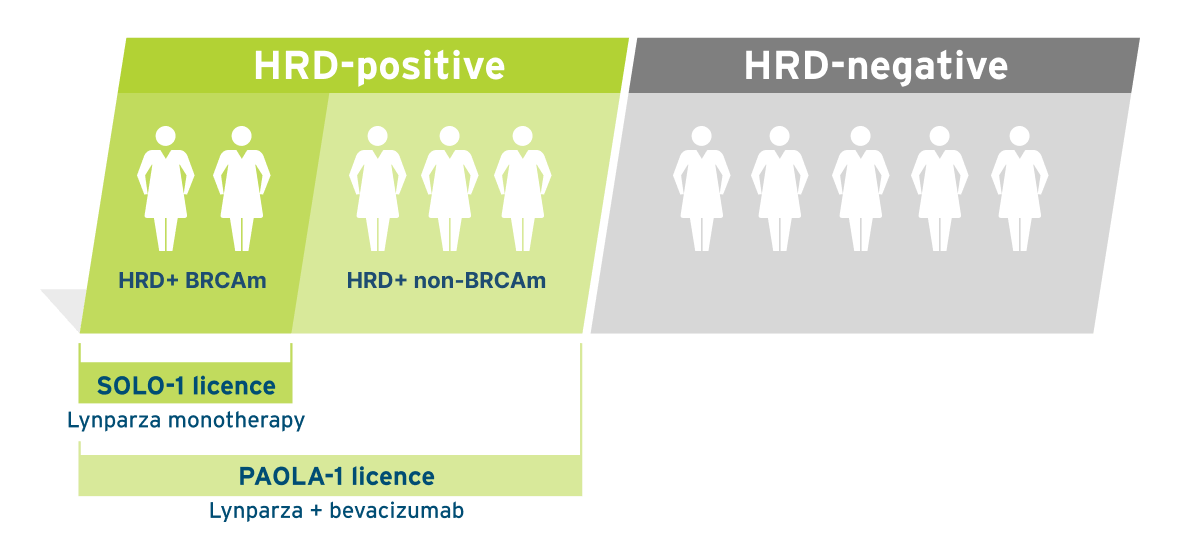
Homologous recombination deficiency is common in ovarian cancer. Approximately 1-in-2 women with advanced ovarian cancer have HRD-positive tumours (including those with a tBRCAm).3-5
HRD testing can provide crucial diagnostic information to guide personalised treatment options for patients with newly diagnosed aOC:1,6
How do PARP inhibitors target HRD tumours?
Homologous recombination deficiency (HRD) is the impaired ability of a cell to accurately repair DNA, and is a hallmark of cancer. Lynparza induces cancer cell death by inhibiting PARP, a DNA repair enzyme utilised by HRD tumour cells.7
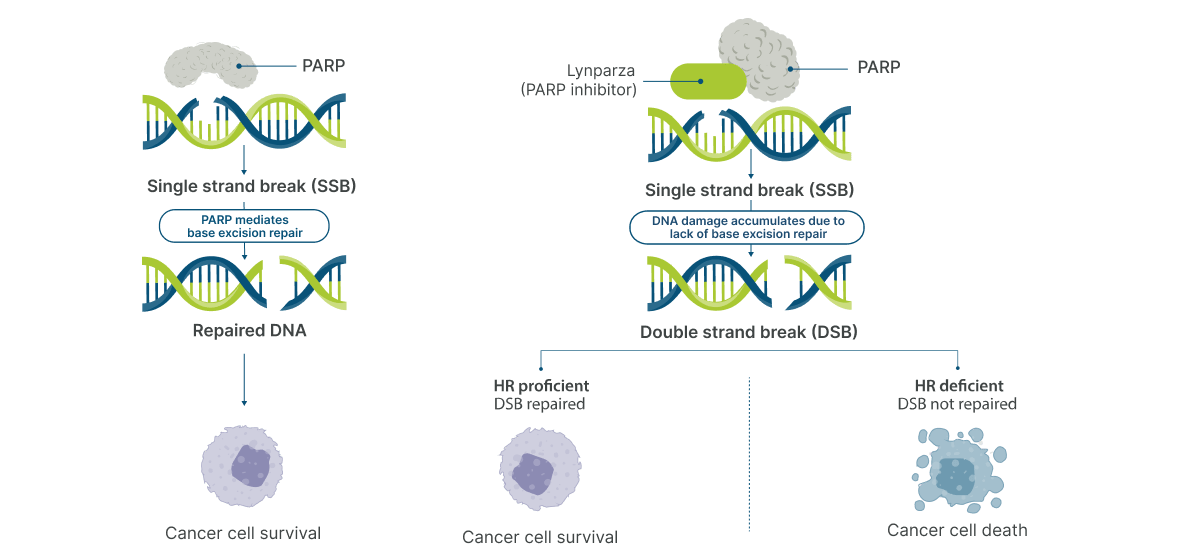
Note: This data is pre-clinical data and should not be extended to the clinical setting. Pre-clinical data suggests a co-targeting mechanism of PARP inhibitors plus anti-angiogenic agents.8,9
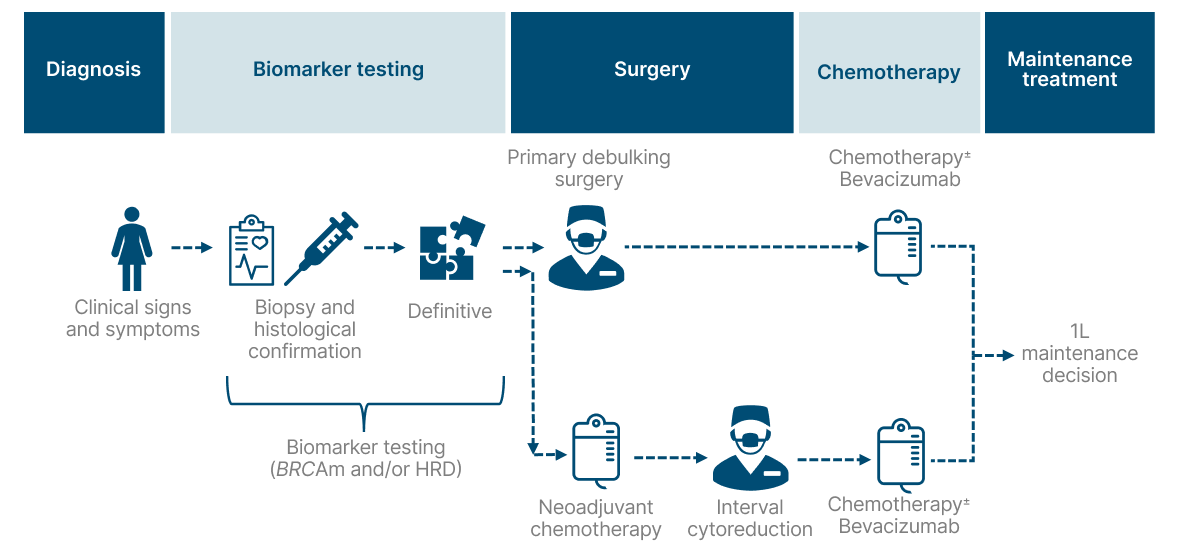
How does HRD testing fit into the patient pathway?
Biomarker testing should be integrated early in the diagnostic pathway, alongside biopsy and histology, to identify BRCA mutations and HRD status. The molecular characteristics of aOC should then be used to direct treatment choices, as recommended by the latest ESMO guidelines.10
All patients with newly diagnosed, advanced (International Federation of Gynecology and Obstetrics [FIGO] stages III and IV) high-grade epithelial ovarian, fallopian tube or primary peritoneal cancer are eligible to be tested for HRD.1
How to request HRD testing
HRD testing is now available through the NHS Genomic Laboratory Hubs (GLH). Please contact your local GLH for more information.
Lynparza tablets therapeutic indications1
Lynparza tablets are indicated as monotherapy for:
- The maintenance treatment of adult patients with advanced (FIGO stages III and IV) BRCA1/2-mutated (germline and/or somatic) high-grade epithelial ovarian, fallopian tube or primary peritoneal cancer who are in response (complete or partial) following completion of first-line platinum-based chemotherapy.
- The maintenance treatment of adult patients with platinum-sensitive relapsed high-grade epithelial ovarian, fallopian tube, or primary peritoneal cancer who are in response (complete or partial) to platinum-based chemotherapy.
Lynparza in combination with bevacizumab is indicated for:
- The maintenance treatment of adult patients with advanced (FIGO stages III and IV) high-grade epithelial ovarian, fallopian tube or primary peritoneal cancer who are in response (complete or partial) following completion of first-line platinum-based chemotherapy in combination with bevacizumab and whose cancer is associated with homologous recombination deficiency (HRD) positive status defined by either a BRCA1/2 mutation and/or genomic instability.
Please consult the SmPC for further information before making any prescribing decisions.
aOC, advanced Ovarian Cancer; BRCAm, BRCA1 or BRCA2 mutation; FIGO, Fédération Internationale de Gynécologie et d’Obstétrique; HR, homologous recombination; HRD, homologous recombination deficiency; NHS GLH, NHS Genomic Laboratory Hub; PARP, poly(ADP-ribose) polymerase; SSB, single strand break; DSB, double strand break; DNA, deoxyribose nucleic acid.
- Ray-Coquard I, et al. Ann Oncol. 2023;34:681–692.
- Konstantinopoulos PA, et al. Cancer Discov. 2015;5(11):1137-54.
- Moschetta M, et al. Ann. Oncol. 2016;27:1449-1455.
- Ray Coquard I, et al. N Engl J Med. 2019;381:2416-2428.
- Lynparza (olaparib) Summary of Product Characteristics.
- Myriad. Myriad myChoice® HRD Technical Specifications. (2017).
- O’Connor MJ. Mol Cell. 2015;60:547–560.
- Liu JF, et al. Lancet. 2014;15:1207–1214.
- Boussios S, et al. Diagnostics (Basel). 2019;9:87.
- Ledermann J, et al. Ann Oncol. 2024;35:248–266.
GB-73569 | Date of Preparation: July 2026
Privacy Policy Terms of Use Contact Us Information for General Public Accessibility
Cookie Preferences
© Merck Sharp & Dohme (UK) Limited 2026. All rights reserved.
© AstraZeneca 2026.
GB-73578 | Date of Preparation: July 2026
Adverse events should be reported. Reporting forms and information can be found at https://yellowcard.mhra.gov.uk or search for MHRA Yellow Card in the Google Play or Apple App Store. Adverse events should also be reported to Merck Sharp & Dohme (UK) Limited (Tel: 0208 154 8000).