Dosing, Preparation, Storage and Administration

KEYTRUDA (pembrolizumab) 395 mg solution for injection Prescribing Information [External link] | KEYTRUDA (pembrolizumab) 790 mg solution for injection Prescribing Information [External link] | KEYTRUDA (pembrolizumab) 25 mg/mL Concentrate Solution for Infusion Prescribing Information [External link]
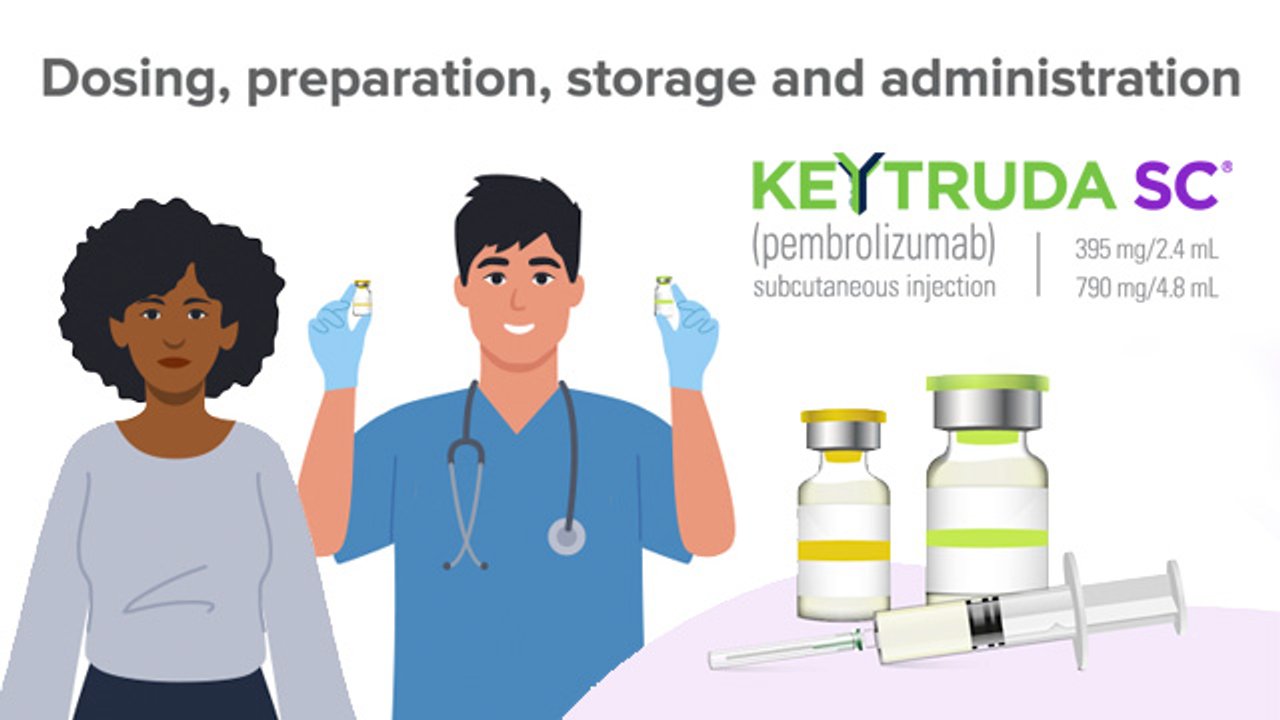
KEYTRUDA SC (pembrolizumab) Dosing and Administration Video
Watch the KEYTRUDA SC dosing and administration video for considerations for storage, preparation and administration for your eligible patients.
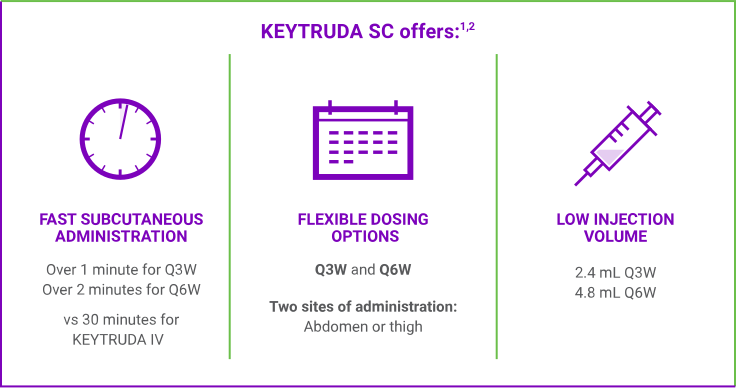
Two solution-strength vials are available for KEYTRUDA SC1,2

*Pembrolizumab
†Does not account for all aspects of treatment. Actual clinic time may vary.

Patients can switch from KEYTRUDA IV to KEYTRUDA SC, or from KEYTRUDA SC to KEYTRUDA IV, at their next scheduled dose1,2,3
KEYTRUDA SC is a distinct product from KEYTRUDA IV: each product has a colour-coded cap to ensure accurate identification
Vial identifications:
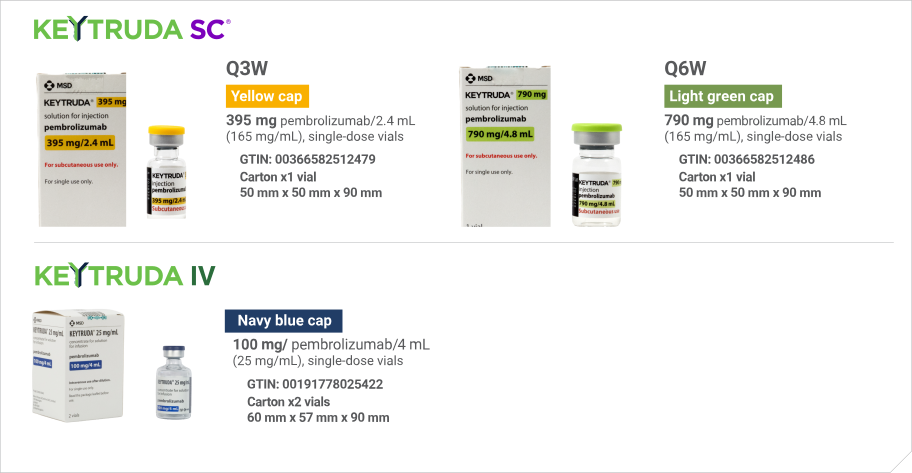
Vials and cartons shown to scale, not actual size.
The KEYTRUDA SC syringe can be prepared for injection in four steps1,2


*Any unused medicinal product or waste material should be disposed of in accordance with local requirements.
How to store KEYTRUDA SC vials and prepared injection syringes1,2,3
Storage of unopened vials

If removed from refrigeration, unpunctured vials can remain at room temperature (≤25°C) for up to 24 hours before preparation for administration.
Storage of prepared syringes
This product does not contain preservative and should be used immediately after withdrawing from the vial. If not used immediately, store the syringe containing KEYTRUDA SC with the transfer needle and cap in place for:


†If refrigerated, the 24-hour period may include up to 8 hours at room temperature.
If refrigerated, the filled syringe must be allowed to come to room temperature for at least 30 minutes prior to administration.

The syringe must not be frozen.
Do not attach the hypodermic needle until immediately prior to administration to avoid clogging.
Discard if storage time exceeds these limits.
Do not store any unused portion of the solution for the injection for reuse. Any unused medicine or waste material should be disposed of in accordance with local requirements.
KEYTRUDA SC is administered over 1 or 2 minutes, with two subcutaneous injection-site options – abdomen or thigh1,2
Should be administered by an HCP and must be administered by subcutaneous injection only.

*Does not account for all aspects of treatment. Actual clinic time may vary.

Key considerations
Inject into the subcutaneous tissue of the thigh or abdomen, avoiding 5 cm around the navel.
Do not inject into skin that is damaged, sore, bruised, scarred, scaly, or has red patches.
Rotate injection sites for subsequent injections (ensure the injection site is at least 2.5 cm from the previous injection site).
During treatment with KEYTRUDA SC do not administer other medications for subcutaneous use at the same site.
For certain patients, treatment with KEYTRUDA SC could offer the opportunity for administration outside an infusion suite.5
KEYTRUDA SC is licensed for use across most KEYTRUDA IV indications, whether alone or in combination with other therapies.1,2,3 One such indication is: KEYTRUDA IV and KEYTRUDA SC, in combination with pemetrexed and platinum chemotherapy, are each indicated for the first-line treatment of metastatic non-squamous non-small cell lung carcinoma in adults whose tumours have no EGFR- or ALK-positive mutations.1,2,3
Please consult the SmPC for the full list of indications and further information to minimise the risks associated with the use of the medicine before making any prescribing decisions.
The approved adult indications for KEYTRUDA SC have been established based on the MK‑3475A‑D77 study, which demonstrated non‑inferior pharmacokinetics and provides a descriptive analysis for the efficacy and safety profile of KEYTRUDA SC compared to KEYTRUDA.1,2
The safety and efficacy of KEYTRUDA SC have not been established in paediatric patients, except for adolescents with melanoma or cHL aged 12 years and older who weigh more than 40 kg. For these adolescents, the recommended dose is the same as that for adults. The paediatric safety and efficacy profile of KEYTRUDA SC is based on extrapolation from intravenous pembrolizumab studies, as efficacy and safety in paediatric patients were not directly evaluated in the MK-3475A-D77 study.1,2
In addition, pharmacokinetic modelling and simulation analyses demonstrated similar pembrolizumab exposure in adolescents aged 12 years and older who weigh more than 40 kg compared with adults, suggesting a similar safety profile. Pembrolizumab exposures with subcutaneous doses of 395 mg every 3 weeks or 790 mg every 6 weeks in adolescents aged 12 years and older who weigh greater than 40 kg are expected to be an average of 30% higher to those of adult patients at the same dose, however this difference is not clinically meaningful.1,2
Please refer to individual product SmPCs for full information about dosing, preparation and administration.
Abbreviations
ALK = anaplastic lymphoma kinase; EGFR = epidermal growth factor receptor; GTIN = ordering code; HCP = healthcare professional; IV = intravenous; Q3W = every 3 weeks; Q6W = every 6 weeks; SmPC = Summary of Product Characteristics.
References
- KEYTRUDA (pembrolizumab) 395 mg Solution for Injection Summary of Product Characteristics.
- KEYTRUDA (pembrolizumab) 790 mg Solution for Injection Summary of Product Characteristics.
- KEYTRUDA (pembrolizumab) 25 mg/mL Concentrate Solution for Infusion Summary of Product Characteristics.
- Felip E, et al. Ann Oncol 2025;36:775–785.
- De Cock E, et al. Adv Ther. 2025;42(12):6175–6189.
Supporting documentation
KEYTRUDA (pembrolizumab) 395 mg solution for injection Prescribing Information [External link]
KEYTRUDA (pembrolizumab) 790 mg solution for injection Prescribing Information [External link]
KEYTRUDA (pembrolizumab) 25 mg/mL Concentrate Solution for Infusion Prescribing Information [External link]
By clicking the link above you will leave the MSD Connect website and be taken to the emc PI portal website.
